Permanent Home of the
ANONYMOUS SHIVA LINGA PAINTINGS
HUDSON COLLECTION





IOWA CONTEMPORARY ART
The Hudson
Collection
More about the Hudson Collection
This inaugural installation in ICON’s Hudson Collection Gallery features the Anonymous Shiva Linga Paintings
exhibited at the 55th Venice Biennale, curated by Massimiliano Gioni, artistic director of the 2013 Venice Biennale and
associate director of the New Museum of Contemporary Art in New York. For the Biennale installation, Gioni selected
31 paintings from the series of 71 Anonymous Shiva Linga Paintings assembled by Franck André Jamme and
Feature Inc., New York. ICON’s exhibition duplicates the selection and sequence of the paintings at the Biennale.
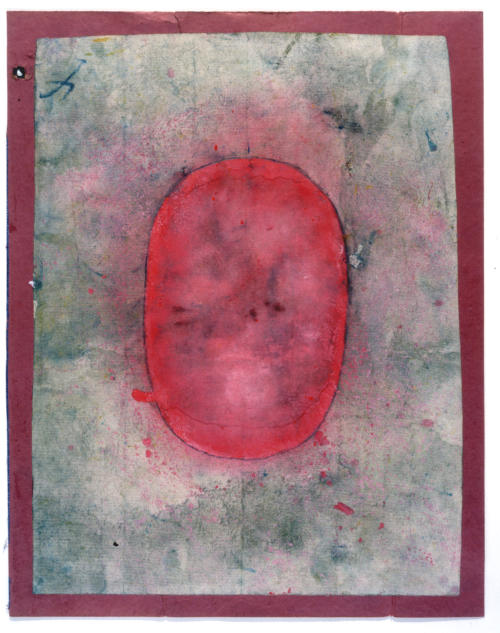
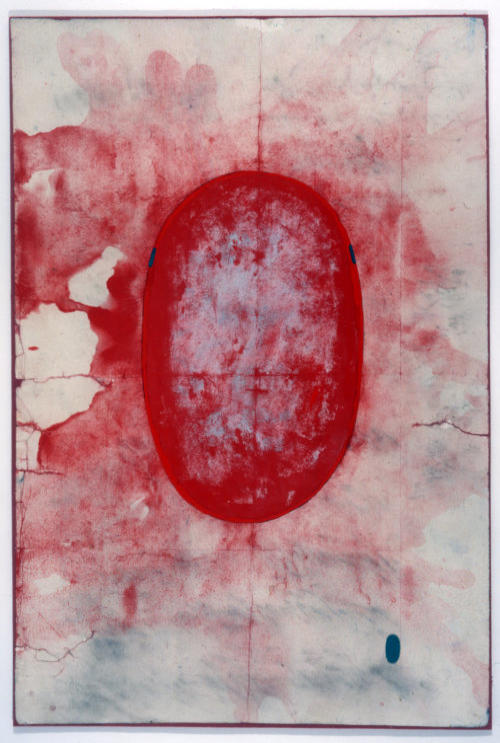
The Shiva Linga is an abstract or aniconic representation of the Vedic god Shiva as an eternal cosmic pillar of fire,
the first and final form of all creation. The three-dimensional stones and two-dimensional drawings of the Linga are
considered by devotees to be not mere representations of Shiva but rather the sacred embodiment of the Divinity.
These Shiva Linga paintings on found paper are made anonymously in India (primarily in Rajasthan) by practitioners
of Tantrism—some of whom are artists—to represent and embody fundamental aspects of Tantra, a vast and complex
spiritual and philosophical practice. Made to awaken heightened consciousness, these devotional images are used for
visualization and meditation as part of Tantra’s spiritual practices. While the images are centuries old with highly
codified forms and colors, the paintings are filled with such a high level of the artists’ intentionality that they continually
appear fresh and alive. The French poet/scholar André Padoux has described these images as “painted silences. . .
the simple revelation of pure consciousness.”
According to French poet Franck André Jamme, who has played an instrumental role in bringing these paintings to
western audiences, the tantrikas who create them work in a focused state of mental rapture. Despite their expression
of an unbroken, centuries-old tradition, the works in this exhibition (made between 1966 and 2004) seem both timeless
and utterly contemporary. They also possess a remarkable affinity with examples of twentieth-century abstract art.
The progeny of hand-written, illustrated religious treatises from the seventeenth century, copied across many generations,
these paintings are part of a distinct visual lexicon that confounds assumed differences between East and West, the
spiritual and the aesthetic, the ancient and the modern.
This exhibition is dedicated to the memory of Hudson, founder and director of the New York art gallery Feature Inc.
The Hudson Collection has been very generously donated to ICON’s permanent collection by Patricia Hudson,
James Hudson, and Thomas Hudson.
IOWA CONTEMPORARY ART | 58 North Main Street, Fairfield, IA 52556
641-919-6252 | bill@icon-art.org | iconbillteeple@gmail.com
GALLERY HOURS: Tuesday through Saturday, 12:00 to 5:00pm and by appointment.
ICON is an IRS 501(c)(3) non-profit educational charity. All donations are tax-deductible.
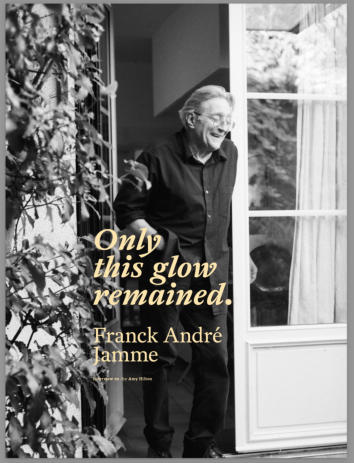
Excerpts from Franck André Jamme’s last interview, September 2020,
“Only This Glow Remained” (by Amy Hilton, TL Magazine)
TLmag: You have travelled many times to India. Let us circle over to these
extraordinary abstract Tantric paintings that you are known for introducing into the
West. How did you discover them?
F.A.J.: I first discovered them through literature. Originally, it was at a bookshop in
Paris where I found a small gallery catalogue about an exhibition that had been held
some years before. The catalogue opened with two texts: one written by Henri
Michaux, the other by Octavio Paz. I discovered something existed in India that was
totally abstract, with such simple shapes and symbols, inside such a baroque
culture. I absolutely wanted to know more about this Tantric art. But I realized that
there was next to no information published about the meaning of these paintings.
So, I decided to go to India in search of them. But the first few trips were
unsuccessful. It took twenty years for us to find each other.
TLmag: Why so little information?
F.A.J.: Because of bad climate conditions, monsoons, rats, insects, careless
conservation… not many survived. Certainly, some of these paintings did exist
before the 17th century, but we don’t have proof of that. And, even the Indians don’t
have real access to Tantrism itself. It is a kind of small secret society in Hinduism. All
is enriched by secrets and a hidden world.
TLmag: Tantrism, as it is known in the West, has been used in quite diverse ways
throughout history to mean various things for different people. It defies easy definition.
F.A.J.: Tantrism is so deep. And, yes, it is not very well understood in the West.
Because, as usual, Westerners think about the parts of it, which often have a close
relationship with sex or eroticism. This is a very important point: a body of thought
that has cosmic sexuality included at its own heart. But there are so many other
parts to it. There is a main part of it about language. The mantras. The Tantrikas are
the kings of mantras. This became so interesting for me. Because of the language.
TLmag: I have read that the ‘way of Tantra’ involves a highly individuated personal
research enquiry: a personalized ontological journey. Essentially, each person finds
her or his own ‘way’.
F.A.J.: You know, I was very lucky. Because a terrible thing happened to me on my
way. On one of my research trips in India I was involved in a terrible road accident
where the bus I was traveling in hit a lorry coming the other way. Around me, almost
everyone died. And the irony of the thing is that I would not have had any access to
the families who were making these little wonders without this accident. It opened
another door… After the accident I was petrified of going back, but with the help of
some friends in Paris, I decided to return three years later. A friend told me to go and
see a soothsayer. A sort of guru. I met the man, and it was one of the strangest
meetings with another human being I have ever had in my life. He looked like a fox.
Really. A pure fox. I told him I wanted to continue my research, but I was so terrified
to do so. He asked me to wash my hands in a large jar of sand. He stared at the
patterns and read the shapes in the sand, made by my hands. They do that in Africa
also. It is a kind of divination… And then he told me that I had paid my tribute to the
deity, to the goddess. He told me I could go ahead with my research. But secretly. I
could show these paintings in the West, but on two conditions. First condition, I
could sell the pieces but only for enough to earn my own living, not to become rich.
Second condition, he said when I would go to meet the families who were making
this art, I must go alone or only with the one I love. He was standing at the door with
a foxy smile and, just as I was about to leave, he wrote down two names and
addresses on a little piece of paper, and kindly handed it to me. I truly thought that I
was going to leave without what I was supposed to find. But he handed me the key.
And I immediately went to the first address. And so, it began like that.
TLmag: Can you expand on the creation of these paintings?
F.A.J.: They were originally illustrations that accompanied hand-written manuscripts.
Over time, they were copied out separately from the texts. Their purpose was to be
used as tools to meditate, to connect with cosmic forces in the larger universe. It is
important to remember that they are made anonymously by people who would not
describe themselves as artists. They do not think for a minute that they are artists…
They are just continuing the tradition of the family. What is so inspiring to me is that if
I send them a commission for a piece, I sometimes receive it one year later. There is
absolutely no rush for them to receive money quickly. And I love that. I really love
that. It is very important for me. They do not react quickly at all. Another thing that
inspires me – this is not at all a patriarchal tradition. There are so many women
painting these pieces. And this is so rare in India. As they are anonymous, we would
never know this.
TLmag: They are so akin to poetry. Visual poetry. I am interested in the actual spark
of creative transmission. These simple geometric shapes: ovals, squares, circles,
triangles. The choice of colours…
F.A.J.: They paint them according to an endless schema, constantly repeated and
passed on from generation to generation in each family. Like a raga in their music –
you start with the scale and then improvise. You have five or six notes for one raga,
but you can play it as you like. You just need to respect the original five or six notes.
They do not vary too much.
When they make these paintings, it is also very much like Indian music – it depends
very much on a feeling at a certain moment, on their inside mood. They are not
going to paint a very powerful and red image if they are in a breezy mindset, if you
know what I mean. It is an inner gesture each time.
TLmag: “Never in the universal history of painting,” you once wrote, “have works
been produced that are both so mysterious and simple, so powerful and pure… a bit
as if, with these works, man’s genius had been able to assemble almost everything
in almost nothing.” They are jarringly affective.
F.A.J.: They are. They vibrate. A Shiva Linga on fire. So full of energy, it is burning.
TLmag: Curiously, I do not see one of them exhibited here in your house.
F.A.J.: It is funny, but yes, I do not have a single piece on my walls. Because
I have been very prudent with these pieces, you know. In a sense I do not want to
show them too much. And certainly, I do not want to see them too much. In a very
strange way, I do not like the idea of possessing them. They are much stronger than
me. They could possess me, but I could not possess them. I do my best for them.
They know that I have done my best for them, for a long time now. They are friends.
Maybe I need their energy. Perhaps they could help. Nevertheless, I am so happy to
have met this art. You have no idea how truly happy it has made me.


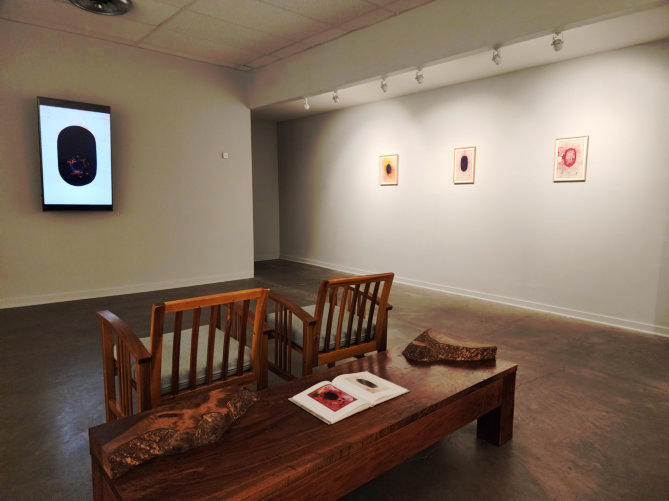
David T. Hanson and Allen Cobb, Slide Show
Anonymous Shiva Linga Paintings/1,000 Names of Shiva,
2014/2017, HD video, color, sound, 48 minutes.
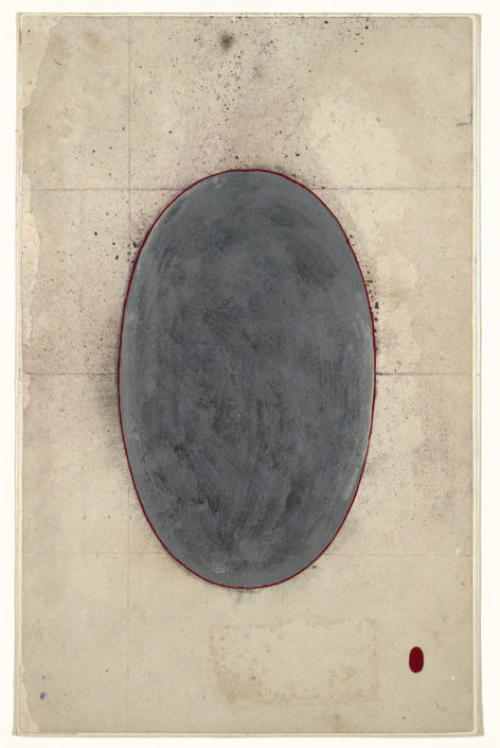
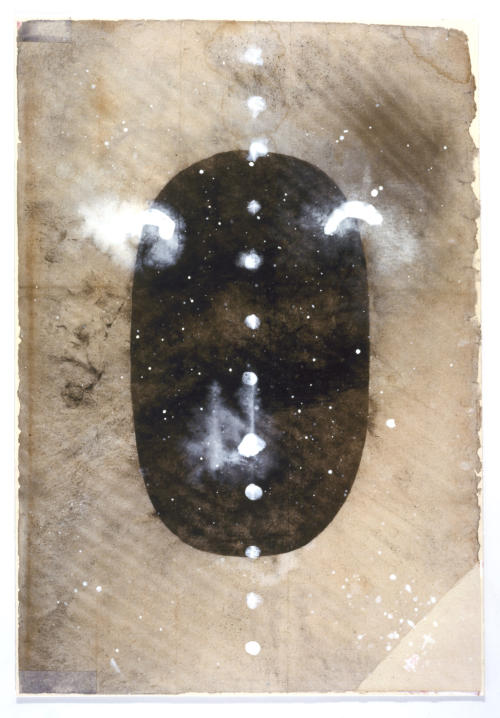
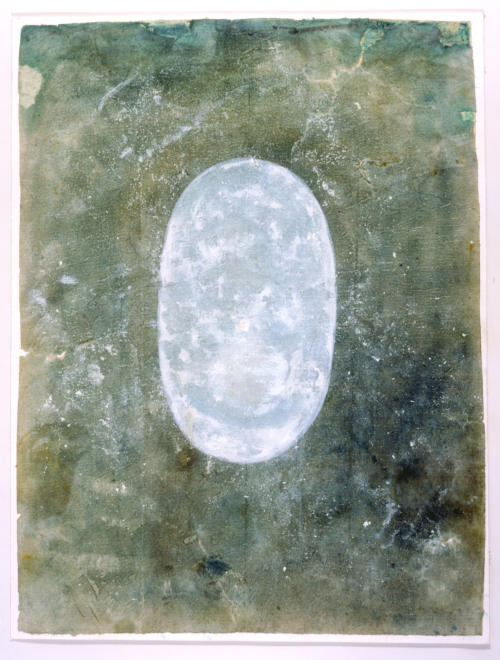
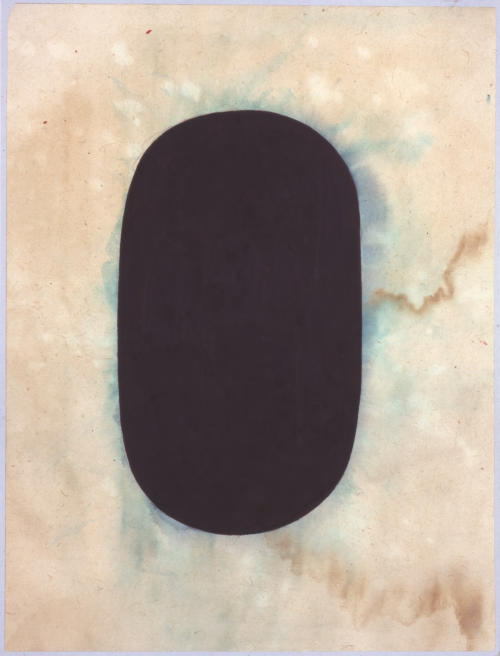
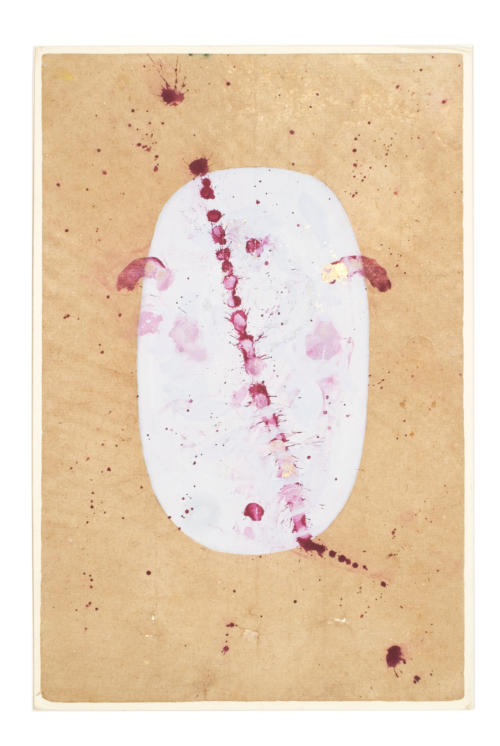
The linga paintings below are anonymous and untitled. The artists use various media
(watercolor, tempera, gouache, ink, hand-made colors) on found paper. The location of the
artist in India, the date of the painting, and the dimensions are listed below.
(Click on images below to enlarge & for more information.)
How this exhibition came to be
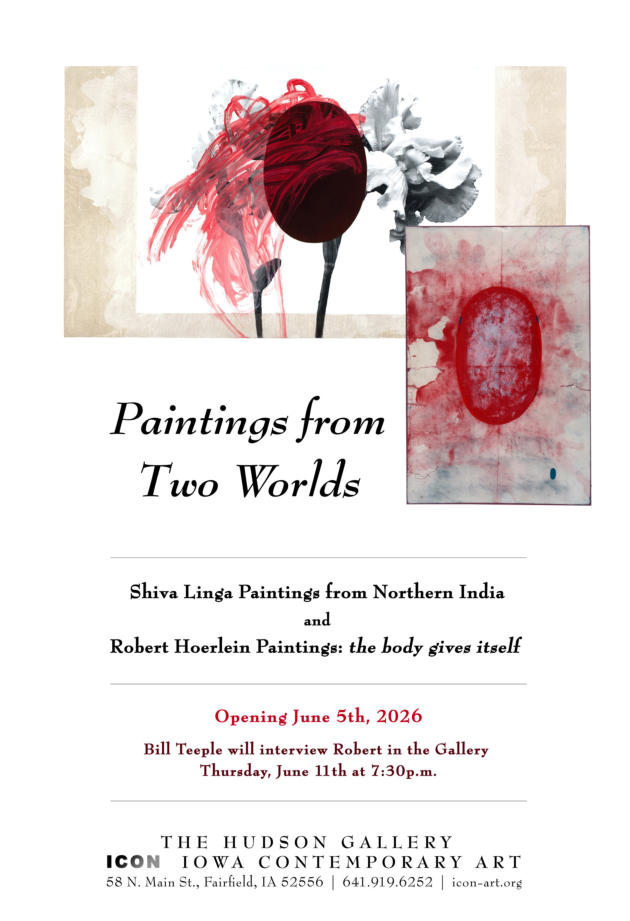
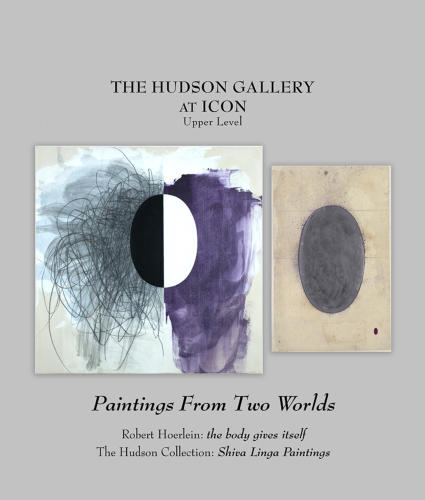
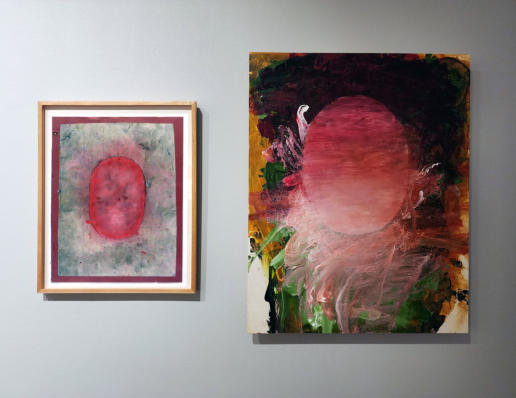
I have been invited to pair paintings from my series “the body gives itself” with
paintings from the Hudson Collection’s anonymous Shiva Linga paintings from
Northern India.
The Tantric paintings were made as part of a spiritual practice, by members of
certain families; they were not created as art objects. First collected by French poet
Franck André Jamme and brought to the Western Art World, they have been
exhibited in many storied venues since 1979, including The Pompidou in Paris,
The Venice Biennale, and Feature Inc, a gallery in New York City. These works
are now in the permanent collection at ICON, Iowa Contemporary Art, in
Fairfield Iowa.
The curators of the Hudson Collection saw a kinship between their works
and mine. Placing these works side-by-side is to see and feel the resonance
and dissonance between two vastly different systems of thought, feeling,
and object making: Paintings from Two Worlds.
Artist Statement for: “Paintings from Two Worlds”
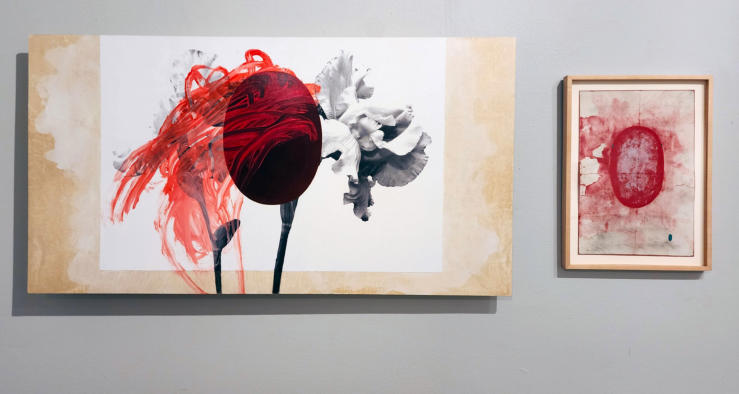
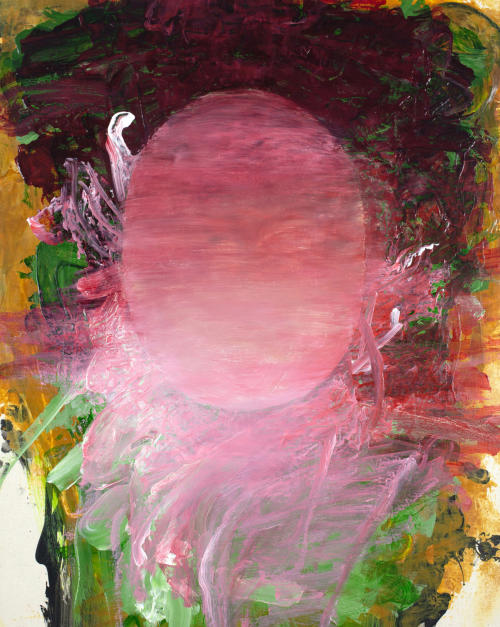

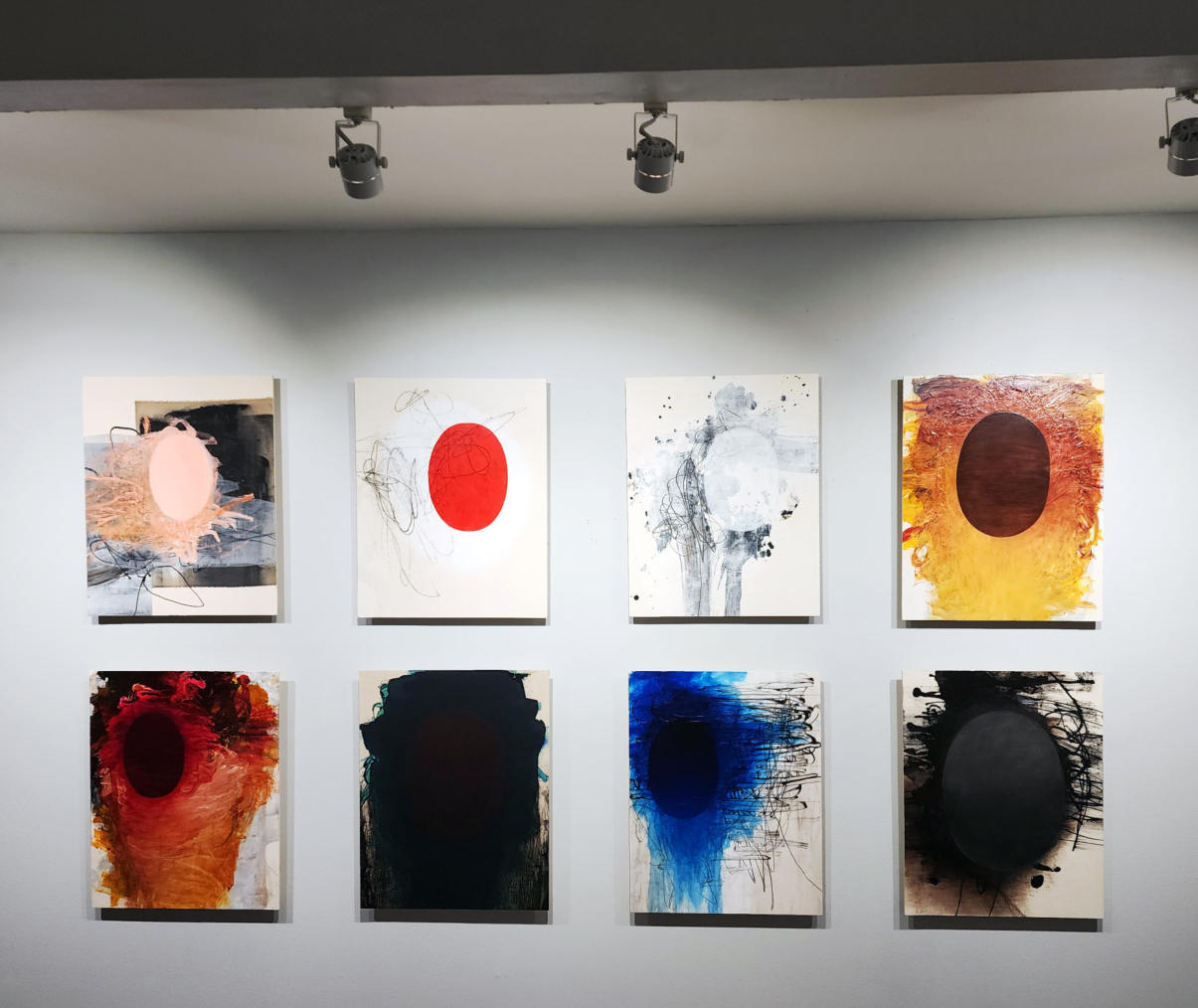
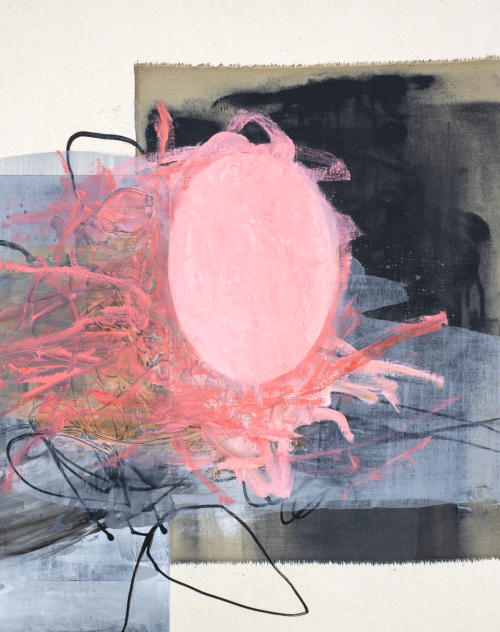
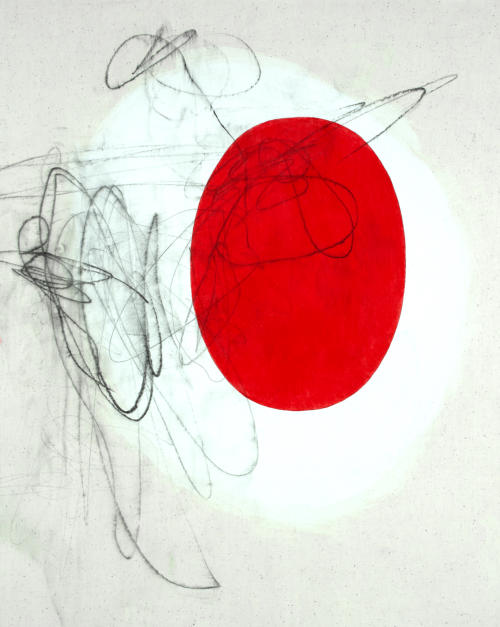

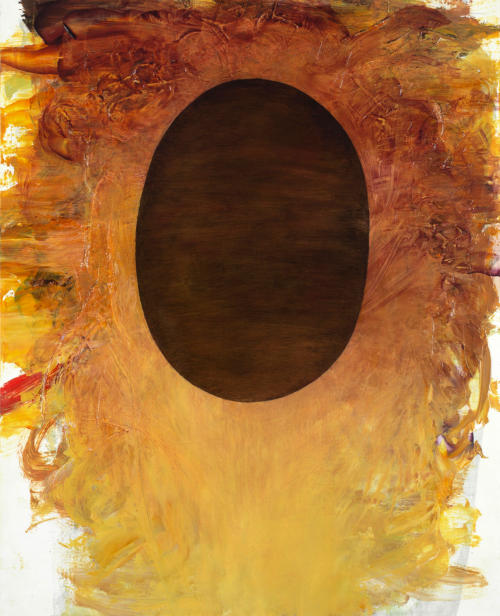
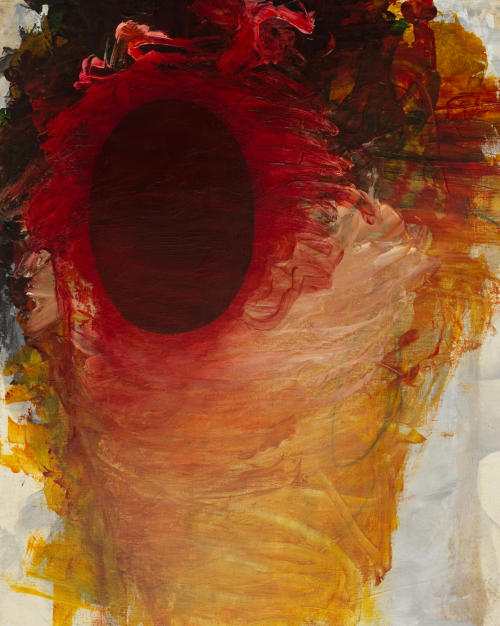
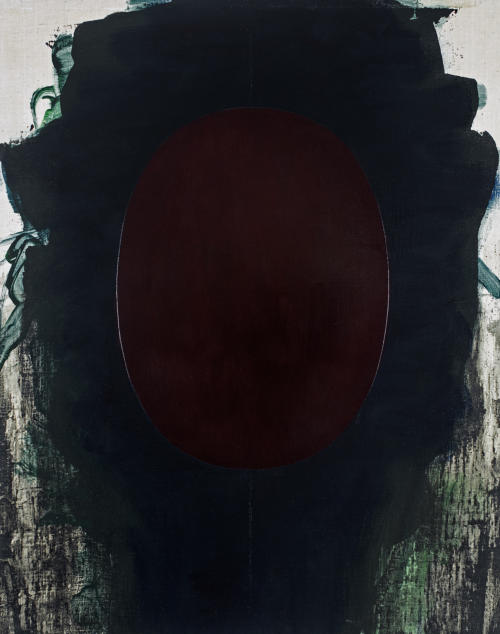
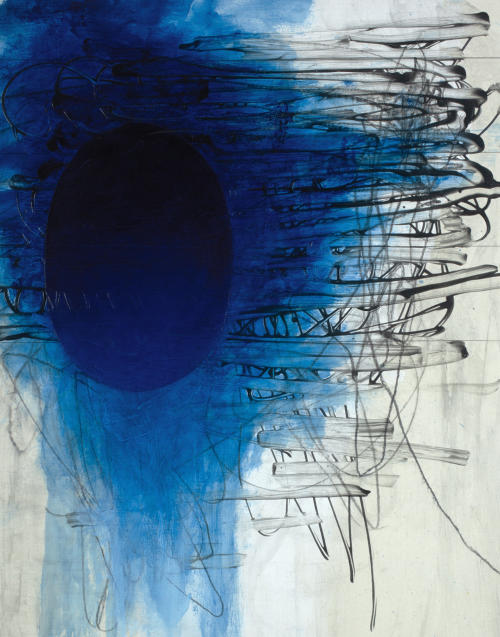
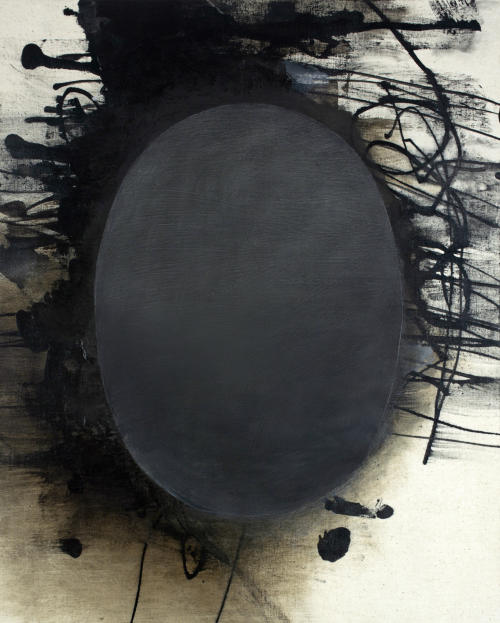
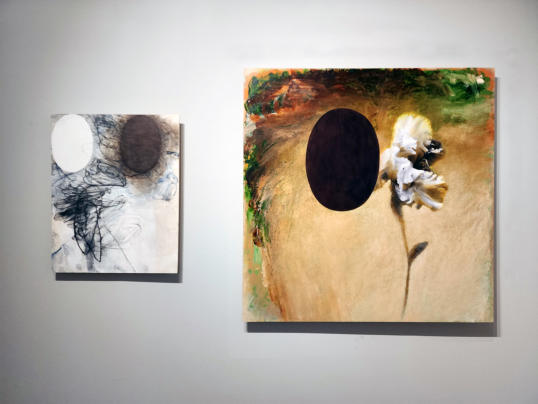

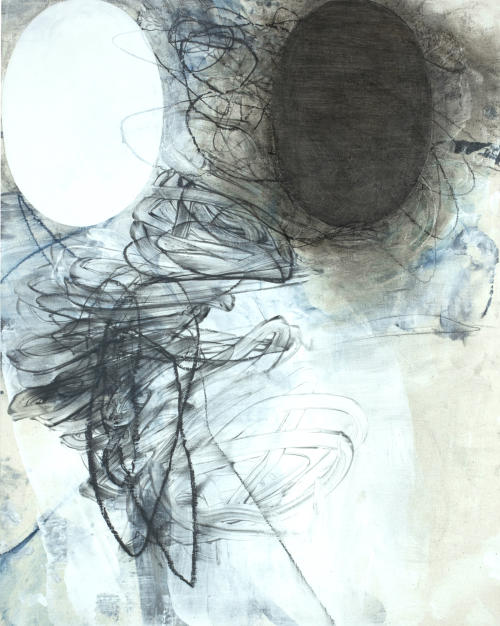
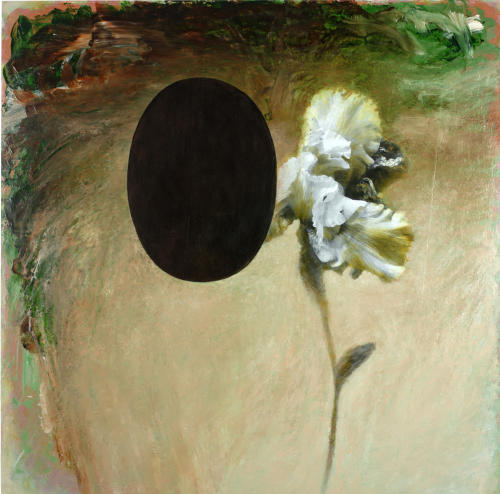
“the body gives itself”, an ongoing series of paintings by Robert Hoerlein
In this series I am exploring this oval “linga” shape, a primal form lodged deep in the human subconscious. This form is universally understood as
a body, a figure. This is to me the simplest form of a body, an essential body — a body without elaboration, perhaps a universal body.
I have for decades painted “centerless” paintings — fields of color and inflection — abstract energy patterns that have been described as gestural
expressionist works. I sometimes encourage these patterns to coalesce into a sort of “body of paint”. I develop a relationship between this painted
body and its specific world of paint.
This oval shape has appeared in some of my paintings for at least twenty-five years. I’m not trying to make a spiritual statement: I’m trying to build
a meaningful painting accessing the structures of Western Art.
I often use rich saturated colors: colors derived from sources in nature and also distinctly un-nature-like sources. To quote Roland Barthes,
“But what is color? Joy. … it would always come as a surprise since color, like event, is new every time…”
I search and inquire, and sometimes I surprise myself. And I hope to surprise you, the viewer.
(Click on photos below to enlarge & for more information.)
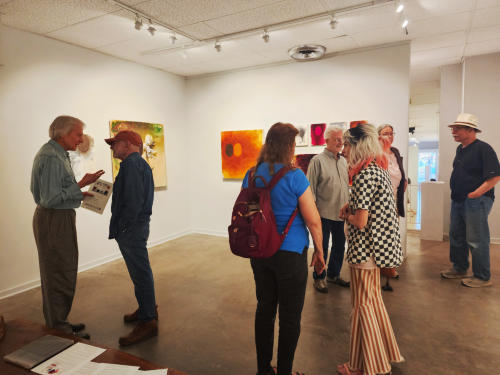
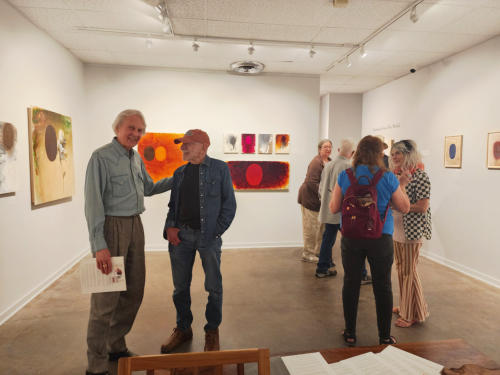
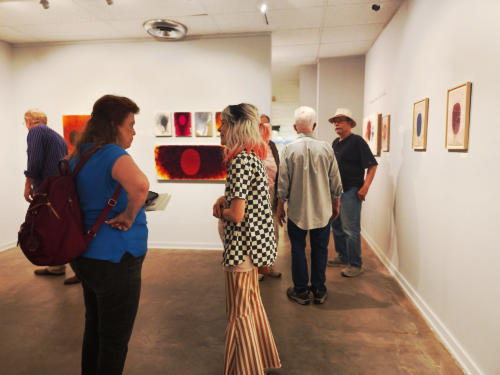
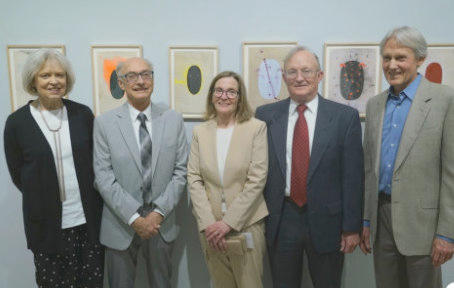
Opening Night